

The Story
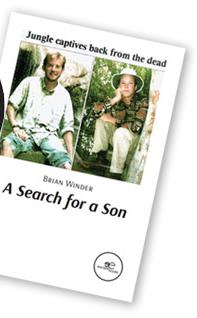
A Search for a Son is an account of a father's attempts to discover what has happened to his son, who disappeared in the Darien Gap jungle in Panama, in Central America. Just how do you go about finding out what has happened to someone six thousand miles away in a Spanish-speaking country?
At the start the father did not know for definite where his son had disappeared, if he had had a companion or who that companion was, or if he had had a guide. The significant thing is that the search became a family affair (without divorce!), but then other people became involved — some complete strangers very generous and helpful, a genuine crook, and two largely incompetent detective agencies. After nine months, it was resolved, free of any ransom demand, probably by direct contact with the guerrilla group, FARC, itself. When the two adventurers were released, the parents, Brian and Anne Winder, heard of ransom demands of $2,000,000 each which never reached them, and many situations where the two adventurers could easily have died, and their fate never be known.
The book is about a very basic instinct: a parent's concern for a child. We think of the 500,000 parents in the First World War whose only information about their son's death was ‘missing in action’. It leaves a deep curiosity and sadness, which never goes away. With medical advances in the 20th and 21st century, parents normally outlive their children, and with electronic contacts, parents and children normally keep in some kind of touch. But what if a child disappears six thousand miles away in impenetrable jungle and high mountains, and you can get no information about what happened? That is the starting point of A Search for a Son.
The Darien Gap
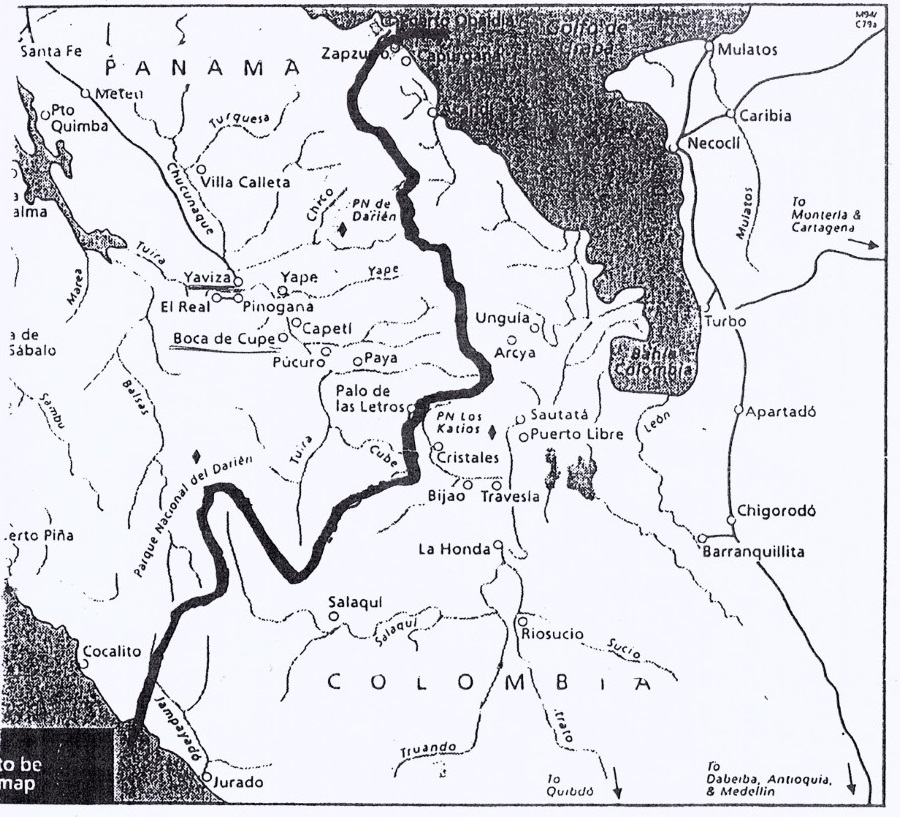
Between North and South America there is no road and no rail. There is just equatorial forest and 6,000 foot mountains. The lack of a road gives more hope that it will remain as it is than most other equatorial forests in the world. A north-east to south-west wobbly line at the top of the ridge forms the border between Panama and Colombia.
In the middle of it is the Darien Gap; the approach to it from Panama is by footpaths and by boat up a couple of rivers. Being thick jungle, it provided a hiding place for the FARC guerrillas as they engaged in armed revolt against the injustices of the Colombian government. Of course, the FARC's presence caused supporters of the government to be present on the edges of the jungle too, making the area a hotchpotch that the Panama police and army normally did not dare enter for the greater part: lawless. On the Colombian side is a national park which had been closed for many years by the year 2000.
A Detective Story
The book A Search for a Son is a real — not a fictional — detective story. Yes, writing at the end of it, you know that the search will succeed. But try to imagine the starting position: the son, Paul, well-meaning, not wanting to worry us of possible dangers, resulting in us being in the dark. We were uncertain where he was going. We simply did not know if he had a companion or a guide, or how long it would be before he contacted us again.
You hear on TV of parents panicking after a person is missing for a day. We remained calm for three months before we started taking steps to solve it. We glanced at websites of detective agencies: they had long initial questionnaires — what discos did the missing person go to, what nickname might they call out to each other in such a disco so that the snoop could go and listen for it, and so on. Daft. And when our next thought was that we might get information from breaking into Paul's emails (new-fangled at that time), Microsoft refused to help us with the passwords unless we could present a death certificate. Near stalemate.
Being Conned
Why were we conned? … and you may say ‘I wouldn't have been conned’. Fact: when early on in the search we were looking for someone with knowledge of the Darien area, and I wrote a two-page article in The Times, an Englishman living in Holland phoned us and offered to help, but said he needed money for expenses. He asked for $10,000 but we beat him down to $5,000, which we gave him. We discovered later that he had also approached the Blackman parents when their daughter, Lucie, had disappeared in Japan. Lucie never came back.
Why did we accept his ‘help’? Well, it was the same as if someone had told a parent after the First World War that their son was still alive and that they knew where he was, after they had been told by the army that he was just ‘missing in action’ — they would quite likely have accepted the offer. It would have raised some hope in place of the great silence.
Knowing People
When you go to live in a new town far away, it is said it takes 30 years to really know it. Maybe an exaggeration — but at least five years. It is the same with tourists. Tourists who stay in first-class hotels learn almost nothing about the places they visit; the idea of such hotels is to make you feel at home. Back-packers are normally closer to the people — in hostels and buses and walking around — but they pick up much of their information from other back-packers.
When we started getting into email contact with those who had visited Panama, they gave us a terrifying picture of the Darien Gap: full of drug agents and murderous guerrillas and gun-runners, left-wing and right-wing. It added greatly to the stress of our son being missing for nine months. Even the British embassies had just surface knowledge, mainly for commercial purposes. But we gradually got in contact with long-term managers of hostels, who gave us a more balanced picture; and when I went out to Panama, a long-term resident, an ex-marine, put me in contact with an Indian, who at least found out where Paul had gone — the first step in tracing him. But it did not allay our fears and worries.
The Kindness of Strangers
The Kindness of Strangers, and … a Family Affair. When we persuaded The Times to publish my article about our search for our son, TV interviews and articles in other papers immediately followed. As a result, not just people we knew and relatives in England and Ireland sympathised — lots of total strangers contacted us too. When Paul's brother, Bill, broke into Paul's emails and contacted Paul's back-packing friends in Panama, or when those people went home to New York or California or Japan, they still sent long emails back to tell us what they knew, full of sympathy.
After that, the boss of an adventure holidays company in America, Patricia Upton, enlightened us on the Darien Gap, and gave us the contact details of an ex-marine in Panama, Eric Nicholaison, who drove me around Panama City to introduce me to an Indian, Margarito, in the compounds, and arranged his visits to the villages near the Darien Gap to enquire. Patricia Upton also introduced me to James Spring, who was a firm support over many months. As for a family affair, Paul's two brothers were busy in support — no sibling rivalry there.
Adventure & Frustration
Let not young souls be smothered out before
They do quaint deeds and fully flaunt their pride
It is the world's one crime its babes grow dull… Vachel Lindsay
The poem is saying that the young may grow very frustrated if they have to buckle down to duty too early in life. And frustration can lead to misadventures of a worse type, like drug-taking or having children they cannot support. I am an old man, but I sympathise with the young, who have no foreign country to explore and no cause to espouse.
For the last 25 years I have helped with and set up organisations for the homeless and addicts and other vulnerable people, largely voluntarily — and helped the local Scouts, who are on the right lines about adventure in young people's lives. And I am lucky in having had a very varied life myself.
About the Author
If you have children it is natural that at some time they will forge their own lives. But you never imagine that they will simply disappear. And it is natural to expect that you will die before them. A hundred and fifty years ago, if they went abroad, you might never hear from them again — but times are different now. Sons and daughters may go missing, but it is normally just for a few days. An odd case hits the headlines and arouses sympathy among us all, like Lucie Blackman in Japan or Madeleine McCann in Portugal. Our case with our eldest son was nearly the same — in Panama.
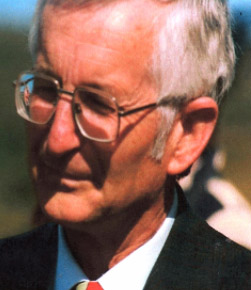
Brian Winder was a family man with three grown-up sons and a long-suffering wife who is a French teacher. He was born and educated with degrees in Classics and Philosophy with the Jesuits in Ireland. In his 20s he travelled in North Africa and most countries in Europe, and most interestingly in Russia when it opened its borders. He taught in a secondary school in Zambia and also worked in the copper mines in Zambia for 11 years, and in London, after he specialised in computers and as an accountant. After retirement, he devoted himself full-time over 25 years to volunteering with many roles in charities serving the homeless and addicts. His favourite hobby was country dancing.
A Eulogy to Brian Winder
Brian Winder passed away on 19 July 2023. Read his eulogy →
Buy the Book
A Search for a Son is published by Europe Books and available from:
It's also available retail at Foyles, 107 Charing Cross Road, London WC2H 0TD (phone 0207 440 1557). The UK/Ireland stockist is Vine House Distribution, The Old Mill House, Mill Lane, Uckfield, East Sussex, TN22 5AA. Retail price is £13.
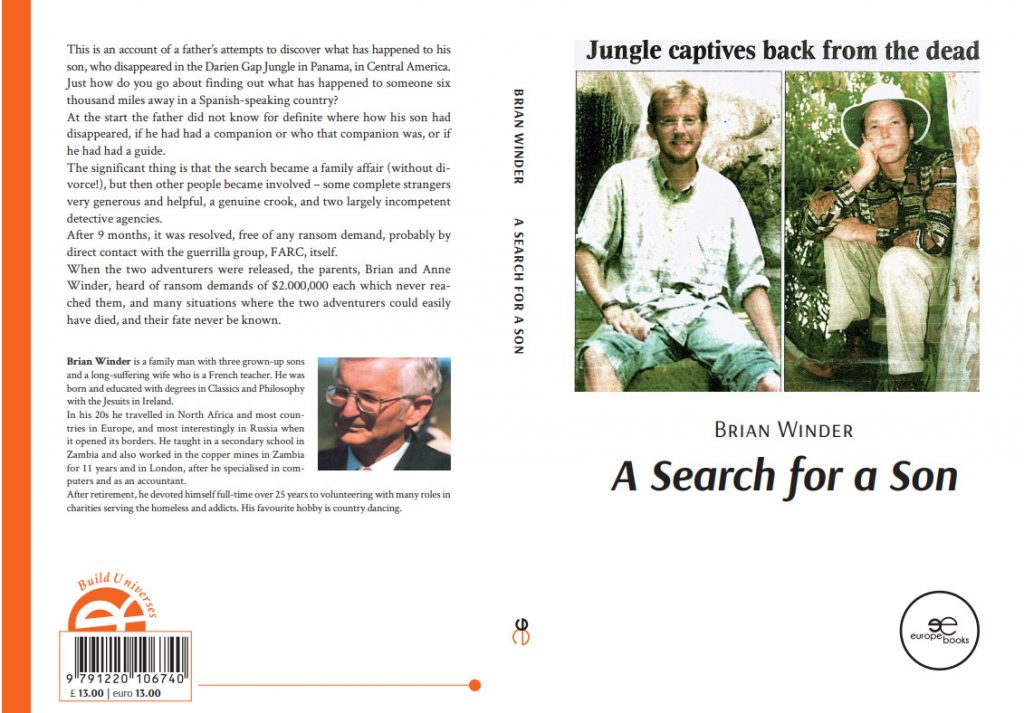
If you'd like to read the other side of this story — Paul and Tom's own account of what happened to them in the Darien Gap — see The Cloud Garden.